What was a Jew looking for on the Temple Mount 1,300 years ago? | Tevet 5786 (January 2026) | Third Temple
This newsletter is dedicated to the souls of the fallen and the murdered Israelis, along with the safe return of all the Israeli citizens held in captivity.
When the light enters – responsibility commences
Hello friends.
The month of Tevet arrives immediately following the lights of Hanukkah. Outside it is cold, the days are short, and the bustle of the holidays is behind us. Yet especially now, when there are no large public events, we are tested by our inner loyalty.
Tevet is a month of truth and consistency. This is the time when we examine whether our yearning for the Temple is just "lights and fireworks," or a profound commitment that accompanies us even through the gray routine of winter.
Thousands of years. Millions of people. One direction.
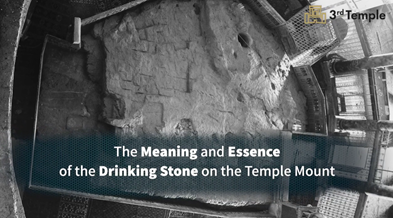
At every point in the world, the Jewish heart turns to the same place: Jerusalem, the Temple Mount, and the mysterious stone at its center.
This is not just any stone. According to tradition, it is the foundation of the entire world – the point from which it all began.
Come learn the story of the Drinking Stone!
Activities
News from the Field: Greetings from 1,300 Years Ago
The Menorah beneath the ground. Even during a month of routine, history continues to converse with us. Recently, an exciting find was uncovered in excavations at the southwestern corner of the Temple Mount: a rare lead pendant bearing the symbol of the Menorah.
The pendant dates back to the Byzantine period—a time when Jews were forbidden from entering Jerusalem. Dr. Yuval Baruch of the Antiquities Authority explains that this is a "personal seal of memory and identity."
This pendant belonged to an anonymous Jew who chose to "wear the Temple" around his neck, despite the decrees and the distance. He did not wait for a built Temple to remember it—he carried the memory with him at every moment. This is the essence of Tevet: keeping the connection alive, even when conditions are difficult.
Photo: Eliyahu Yanai, City of David
Each month brings a new light to creation. Each month has its unique and special spiritual essence. The wisdom of Kabbalah teaches us that the axis of a person's correction is the time within which the person moves. Time operates according to a circular characteristic. In the Book of Creation, the essence of the month of Tevet is linked to the degree of anger and the unique letter for the month of Tevet is the Hebrew letter Ayin (ע).
How then do we distinguish between negative anger and positive discipline? Between anger that removes wisdom and anger that comes from wisdom? What are the spiritual forces at work in the month of Tevet and how can we use them for spiritual development?
The month of Tevet is the peak of difficulty in the annual race: the peak of friction with difficulties and routine. At the same time, anger also has a role in the world. On the one hand, "everyone who is angry... his wisdom departs from him" (Pesachim 60:2), is the great enemy of the soul, the negative quality of irritation and anger in the human soul. But on the other hand, the wisest of men says: "For in much wisdom comes much anger" (Ecclesiastes 1:18). What he means is: wisdom allows anger. Anger, like any bad quality, is a type of power that must be channeled in the right direction through wisdom. In the inner correction of anger lies our greatest correction, the correction of pride and the sense of being.
Righteous anger is the righteous rebellion against the shortcomings that exist in reality. In various places (Chazal, etc.) when they seek to criticize someone, they use the term "strictness" instead of the word anger. Of course, one should be careful that the plans do not come true. Righteous anger is constructive criticism.
Wisdom is a source of life and the choice is ours where to plant the seed, especially in this month. "Wisdom will live on its own" (Ecclesiastes 7:12).
The letter "Ayin" symbolizes the organ of vision. The eye allows the gaze to be focused. He knows how to be angry in the right place and to the right degree from a positive gaze.
If a person is able, when angry, to point out precisely what he is angry about, what the real disadvantage is that he has identified here – this is positive anger, anger that comes from "beautiful eyes."
This type of anger also allows for proper treatment of the problem. This type of anger will not appear in the form of a loss of control, but in a measured, controlled and effective manner. The goal is to know how to control anger, and use it to promote and optimize reality.
This month, we need anger from a good eye, constructive criticism in which everyone forms their opinion on the things that need correction in reality and thinks about how to do so in an effective and wise way.
This is the month when the annual work reaches its peak. The peak of the year's creativity. This is the time to try to identify his creative place in the world, and to channel this tremendous power of the urge for anger into pure creation.
The enormous energy of anger can be channeled into increased spiritual growth. To create change, we must connect to the spiritual root.
So, the main point of our correction in the month of Tevet is to bring God everywhere, in everything, in all the details of the reality of our lives.
The letter of God is the letter Vav (ו), the connection letter. In the letter Vav, the power is revealed to connect opposites, to connect kindness and justice, to connect a divine soul within a physical body, and more, and ultimately to connect back to the root. It is written that all justice is sweetened at its root, all shortcomings are sweetened at their root. When a person notices that he is angry, it means that he did not put the letter Vav in the right place. The letter Vav represents the pillar of the Torah, which if we put more spirituality into this month, we will be able to see the great goodness in everything and the month will turn from good to good.
That is why it is written in the holy books that the correction of this month is to strengthen one's spiritual vision. To strengthen one's vision of goodness. If we have enough wisdom to bring God, the will of God, into it, then truly everything becomes good.
It is important to emphasize that on 10 Tevet, there is a fast, the day when Nebuchadnezzar began to wage the siege of Jerusalem, it was the beginning of everything, which ultimately led to the destruction of the Temple, to this day.
The destruction began the moment the siege is not just a physical wall, it is a siege of consciousness. Jerusalem became isolated and the connection between the Temple and the People began to sever. It didn't happen all at once in a great fire, but through a "silent siege."
If the siege is a disconnection, the rectification is breaking through that mental siege. We don't wait for the Temple to descend from heaven to connect to it. The Tikkun starts when we refuse to get used to the “siege”, we refuse to leave it as a historical memory behind the walls of the past and instead turn it into a living, breathing, and relevant need—here and now.
The light of redemption is shining, even in the darkness of exile, to redeem Israel and save them from the present collective and individual troubles. Therefore, our prayer is that God, the Almighty, will see to it that He will begin the complete redemption, and together the Third Temple will be built on the Temple Mount in Jerusalem in peace.
(From Rabbi Hagay Lundin and Rabbi David Agmon)
"Where there is no truth, there is no peace” (Rabbi Nachman of Breslov)